
Python is a Love Language
Why Learn Python Today?
Gary Chapman’s “The Five Love Languages” is recommended reading for everyone, in my opinion: words of affirmation, quality time, gifts, acts of service, and physical touch. In programmer-land, I would like to nominate Python as the sixth.
I have maintained the stance that a language is a tool, and you should always use the right tool for the right job. As Maslow said, if the only tool you have is a hammer, then it’s tempting to treat everything as a nail. But you are not Thor, and even the god of thunder uses an axe these days 😅…
Still, everybody gets to pick favourites (except parents), and in a world of programming tools, Python would be my hammer.

(Forgive my MCU nerdiness)
IN my experience, Python has a particular way of bringing people together. It makes room for the beginner who is just trying to make a computer say something, the researcher trying to understand a dataset, and the software engineer automating a very annoying task at 2 AM. And somehow, they can all read roughly the same code.
That should be a kind of love language, no?
My First Steps in Python
I started programming with some so-called hard-core languages: C, C++, and Java, you know, the languages with braces, semicolons, and static types. Anybody who has worn braces before knows that they serve a good purpose, but in the long run they are not fun, they hurt, and they can cause headaches… when it comes to writing code, it’s basically the same story: they are not fun, they can hurt (your feeings 😂), and they definitely cause headaches! As for semicolons, let me not go there… trauma!
But to their credit, a program written in one of those “hard-core languages” looked like a serious document, as it should, thank you very much.
Then somebody showed me Python, where a missing space could break your code.
I was offended.
I had been trained to believe that indentation was decoration: a nice thing to do when you wanted your code to look presentable. Python said, “No, no. The indentation is the code.” It felt unreasonable. What if my tab key had a bad day? Should I even be leaving my code’s design to the hotly debated tabs-vs-spaces argument? – CLICK THAT LINK AT YOUR OWN RISK! 😂
And then there was this:
// Hello World in Java
public class HelloWorld {
    public static void main(String[] args) {
        System.out.println("Hello, World!");
    }
}
// Hello World in C
#include <stdio.h>

int main(void) {
    printf("Hello, World!\n");
    return 0;
}
Versus this:
# Hello world in Python
print("Hello, World!")
Surely I was being punk’d!
You call that a program? My grandma could write th- oh wait… that was the whole point! Accessibility. Lowering the barrier between an idea in your head and a small experiment on your screen.
Python asks you to care about what the code says, not only what the computer will tolerate. Once that clicked, the indentation stopped looking fragile. It started looking like an agreement: if code is meant to be read, let us make reading it part of the deal.
The People Behind The Code
The reason I’ve stuck with Python as my go-to language for something like a decade now has much less to do with print() and much more to do with people. The Python Software Foundation has fostered a community that lives and breathes beyond the computer screen!
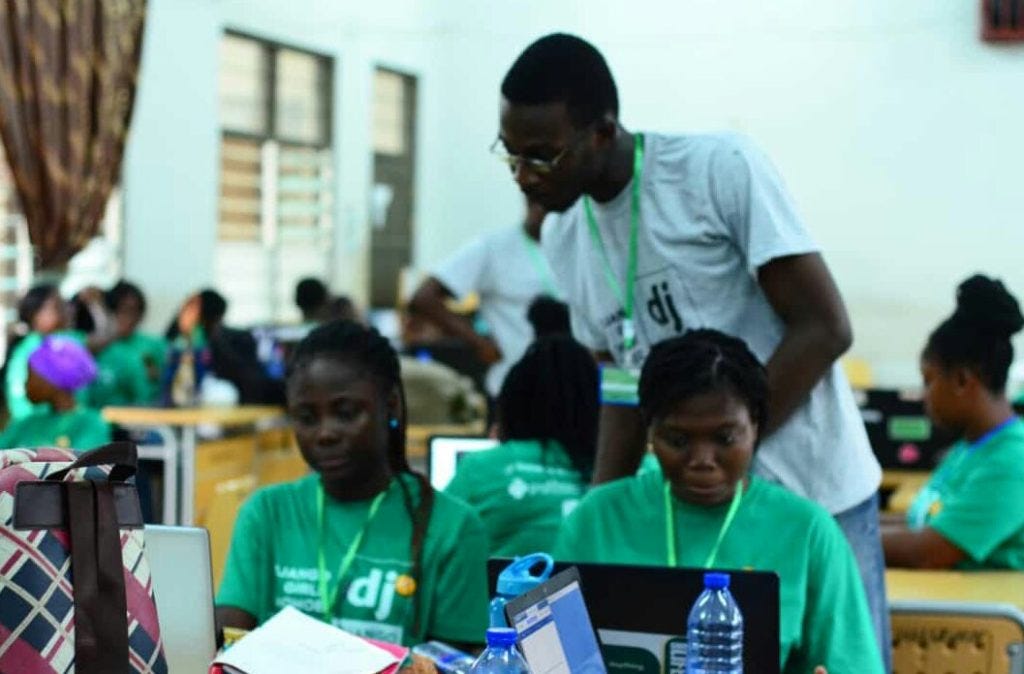
Python took me into the Django Girls community, first in Accra and then in Hohoe. I got to sit with women who were learning to code for the first time, work through the basics of Python and Django with them, and watch them build their own blogs. No one becomes a developer in a day, but a day can be enough to show someone that programming is not a closed club.
That mattered to me. Teaching has a way of revealing what you actually understand, but it also reminds you why you learnt something in the first place. There is a special joy in watching someone go from “I have never done this before” to “wait, I made that.”
The same thing happened when I found Python’s data-science community. My journey into machine learning involved notebooks, TensorFlow workshops, Google Colab, Kaggle, and asking questions when one cloud notebook decided to misbehave at the absolute worst possible time. I wrote then about finding help through the PyData Ghana community. That is another Python superpower: when you get stuck, there is usually someone who has been stuck in a surprisingly similar way and has written a notebook, a blog post, or a very patient answer about it.
Along the way, Python gave me rooms to learn in and rooms to speak in: DevFest, IndabaX Ghana, PyCon Africa, Ashesi University, and eventually DjangoCon Africa. These were not just conferences where people showed slides and collected stickers. They were places where people shared opportunities, swapped half-formed ideas in hallways, and made it easier for the next person to begin.
Finding The Flame Again
COVID. A lot of those rooms disappeared. Like many people, I got busy surviving, studying, and eventually ended up in grad school. Community felt like something I had done in a previous life.
Then I went to DjangoCon Africa in Zanzibar. I met old friends, made new ones, gave my first talk in three years, and became a Django Girls coach again. It was a reminder that the language had never been the whole thing. The language was the excuse for people to show up for one another.
Apparently, community flames are not as easy to put out as I thought. You just need to touch wicks with someone and boom, you are back on fire. 🔥
Since then, I helped start Python Rwanda, and I’m back to serving with Python Ghana since I moved back home.
But AI Writes Code Now, Right?
Right. And that is exactly why I think Python is still worth learning.
The 2025 Stack Overflow Developer Survey notes that Python adoption grew again, and it is the most popular language for learners. I won’t pretend this is proof that Python is anybody’s soulmate, but it is a useful signal: people are still reaching for it across data, automation, web work, and AI, and especially those learning something new in the world of technology.
Andrej Karpathy has a useful way of describing the changing world of software: traditional hand-written programs as Software 1.0, models trained on data as Software 2.0, and a newer world where we increasingly direct large language models in natural language—Software 3.0. His talk on how software is changing is worth watching.
You could look at that and conclude that learning to code is finished. The computer can now produce code cheaply! Everybody (Cynthia Ofori to the Ghanaians) go home!
I think the opposite is true. When generating code becomes cheap, judgment becomes more valuable. You still need to describe what you want clearly. You still need to recognise when an agent has called the wrong tool, read the important parts of what it produced, test whether it works, and decide whether it should be allowed anywhere near production. You cannot audit magic with vibes alone. Understanding code is our best bet at staying in the loop with AI-enabled systems.
Python is a particularly friendly place to build that literacy. It is readable enough for a beginner to follow, useful enough for a scientist to explore with, and practical enough to build an agent, clean a dataset, call an API, or automate the repetitive thing that has been ruining your Tuesday afternoons. It does not replace depth. Heck, it can’t. But it gives more people a way into it.
In my opinion, Python should be a language that every child learns to code in school. Newton developed his laws of motion and calculus in his adult life, but I learned them in high school. Today they are considered basic. That’s the future I envision for Python, one where a kid from Kaneshie in Accra, Ghana, can have Tuesday homework where she’s asked to debug a faulty automation script Claude wrote, because the language is so dead simple, and the complexities have been reduced to child’s play.
In my finals for high school biology, I was asked to draw the leg of a grasshopper. Maybe some people found it useful later in life… I certainly didn’t. The homework task I described above, though… that would have made a difference in my career today. Just a thought.
The Zen Is Still Zen
Near the end of Python’s story sits The Zen of Python, a small collection of principles that somehow manages to be earnest, useful, and a little cheeky. “Readability counts.” “Simple is better than complex.” “Explicit is better than implicit.”
Those ideas were good before AI, and they are good now. In fact, they may matter more now that so much code can arrive fully formed, fast, and confidently wrong.
So if you are a Python person wondering whether the language still has a future: yes. Learn the new tools. Build with the agents. But keep learning to read, reason, test, and explain. Better yet, take someone with you. Answer a question. Review a pull request. Coach at an event. Share the little thing you figured out after three hours of suffering so the next person only suffers for twenty minutes.
Python is not the only language I speak. But it is one of the languages through which I have found work, curiosity, community, and a few people willing to help me make sense of the machine.
That sounds like love to me. ❤️
✌🏾😎
PS. If you enjoyed this article and you’re in Ghana, I invite you to PyCon Ghana 2026! Yours truly is on the program. Let’s connect! Ticket sales end on August 12, 2026.